
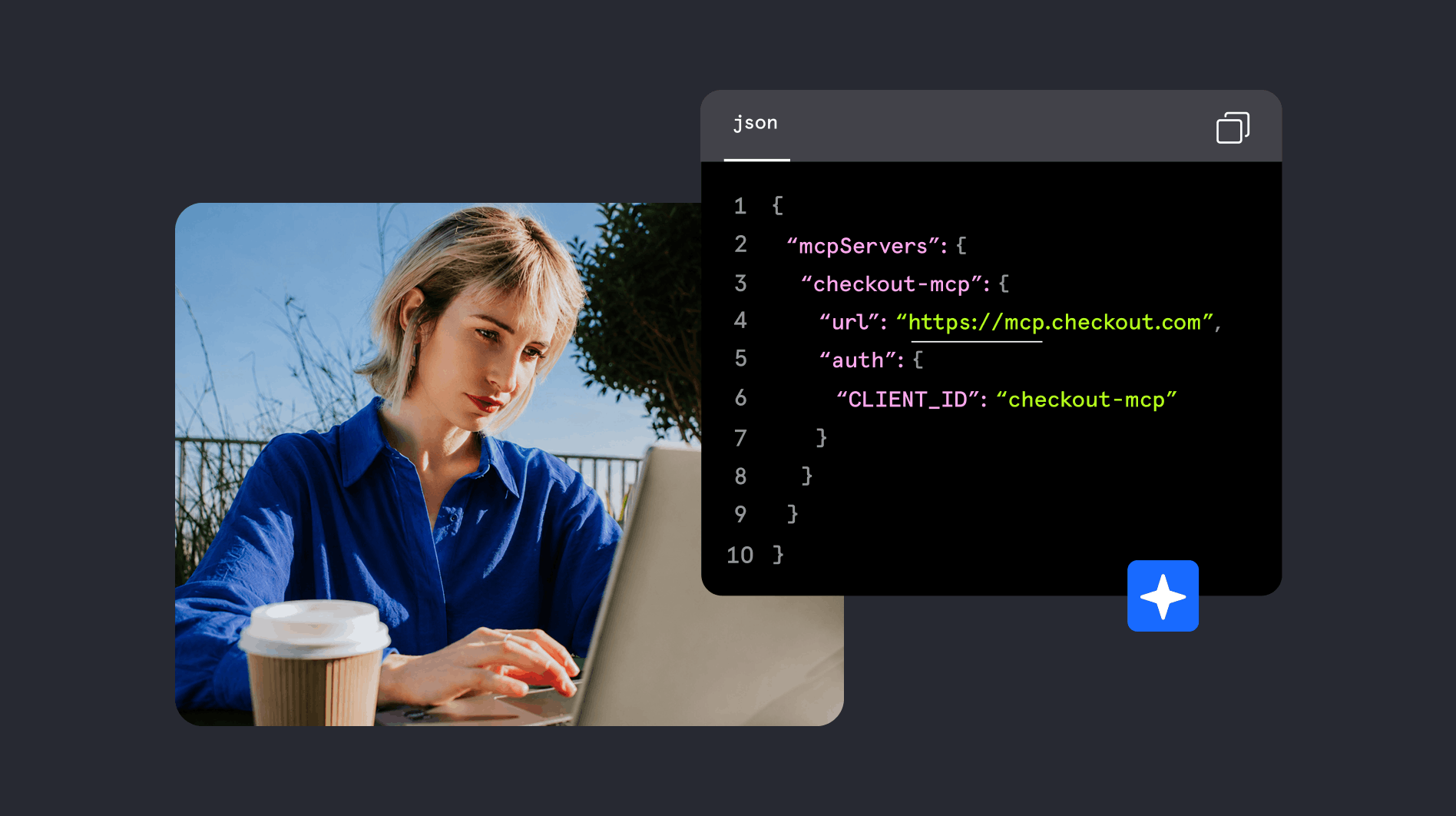
At Checkout.com, AI is not an afterthought, nor is it an add-on to existing tools that don’t need it. Instead, our technologists continue to build out AI infrastructure that helps you scale agentic operations today and tomorrow. Such architecture is essential to realize the full potential of new AI technologies – and overcome the inefficiencies of yesterday’s ways of working. My colleagues already wrote about how we use adaptive machine learning models to raise your payment performance. This article explores how we are upgrading the ways you can connect with Checkout.com using AI agents and LLM platforms.
When scientists designed the spacesuits for the Apollo moon-landing in the 1960s, they wired microphones into the astronauts' caps so they could keep in touch with Mission Control. It ran on analogue radio. Today, engineers building spacesuits for Mars are embedding digital audio processing, background noise cancellation, and voice-activated commands. Because a new mission needs a new spec; a new environment calls for upgraded tooling.
Today’s Integrated Development Environments (IDE) are rapidly upgrading, too. Though your mission may not be Mars, your ambitions depend on future-oriented technology. Since Anthropic launched Model Context Protocol (MCP) in late 2024, there’s growing evidence that the open-source standard is becoming the industry’s baseline for excellent AI integration. Indeed, 72% of technical professionals expect their use of MCP to increase this year, with just over half using it to create MCP wrappers around existing APIs.
New tooling for AI-ready environments
At Checkout.com, we built the Checkout.com MCP Server as a live link that brings expert guidance and operational tools directly into merchants’ favored development environments, like Claude Code, Cursor, and GitHub Copilot. This protocol bridges the gap between AI's reasoning and Checkout.com services, enabling technical teams to build confidently with AI agents. Rather than manually reading through documentation, developers can query API schemas, search documentation, and test flows with simple natural language prompts. In fact, since launching MCP, we’ve seen a reduction in the time it takes to integrate by 81%.
When you’re expected to reach higher levels of productivity, you need to know you can trust the data your LLM presents to you and the guardrails it operates within. With our MCP Server, you can accurately call and retrieve lines from technical documentation and API schemas, not just rely on your LLM to perform a fuzzy web search or generate its best guess based on training data. This helps you to save tokens, as the MCP directs the LLM to the precise source material it needs.
The Checkout.com MCP’s capabilities extend beyond development into day-to-day payment operations. Now you can type natural language commands into your LLM tool and use the MCP to query payment status, manage payment links or securely execute actions such as refunds, disputes and voids directly within your preferred workflow.
You can set up your MCP access, authentication and guardrails directly via your Checkout.com Dashboard. Your permissions will mirror your Checkout.com Dashboard account, so you know exactly what your agent can and cannot do. We also have guardrails in place to ensure predictable behaviour.
Empowering engineers and payment managers
Your business needs to scale fast – and smart. It’s no longer enough to offer better products than the competition: you also need to continually earn the trust of your customer base as you grow. That means smooth UX, reliable payment flows, and dependable technology. We know that 70% of online consumers abandon their purchases due to negative user experiences. That’s tangible business damage you can’t afford when you’re competing for market share.
Think of the Checkout.com MCP as a trustworthy connection to Checkout.com’s developer tools and payment operations. The uncertain engineer can use Support Search and Guide to query which integration would best fit the use case at hand, and weigh up the trade-offs of each pathway. This saves valuable time trying to track down answers in online forums or scheduling conversations with colleagues. All skills are available in Sandbox as well as Production, enabling you to test safely with AI before you instruct an agent to use your production credentials.
For payment managers, the Checkout.com MCP enables the execution of day-to-day payment tasks from within their environment of choice, reducing the need for navigation, exports, or tickets. That means less context-switching and more focused workflowsThis can support your business growth, allowing you to ship more products and support more customers without necessarily increasing headcount.
Expanding AI-first capabilities
The Checkout.com MCP ensures that technical and operations teams have the infrastructure required to automate workflows and scale services in the emerging AI economy. We are excited for what lies ahead, as we continue to build out AI-ready tools for the future of payments.
We are transforming the MCP into a native payment layer for merchant agents, moving from simple assistance to autonomous workflows and multi-step operations. We are constantly expanding our agentic infrastructure suite so you can master productivity in the new AI era.
These priorities underscore our commitment to helping merchants thrive with the latest trusted, efficient and compliant payments architecture. If your developers aren’t already using the Checkout.com MCP for improved productivity and more accurate engineering, look into our MCP Server documentation for further guidance.

.png)




%20thumbnail.png)

.png)


%20(1).png)