How we built an AI payment optimization system that gets smarter every day
All payment service providers seek to optimize acceptance rates and reduce fraud. Few approach optimization from its foundational POV: “is there a way to harness AI for its powerful computational capability while retaining the flexibility for human judgement to make improvements where beneficial?” The gap between good and great acceptance rates isn't a single breakthrough – it's the rate at which you find, test, and deploy the next one.
Focus, expertise, and reach
Our starting point is structurally different. We have data from many different markets, working with vastly different issuing banks, with different needs and requirements. This has built up a pool of deep knowledge and nuance which feeds into our system and helps us continuously improve our model. Our models train on the signals of large established global enterprise businesses. Without the noise of millions of SMB transactions, our fraud models are sharper, our optimization patterns are more reliable, and the edges we find are more predictable. That’s a design choice that compounds over time.
Machine learning has been at the foundation of our payment decisions for years – powering fraud scoring, routing logic, and authentication strategy across billions of transactions. We have deep experience in ISO 8583 constantly adapting to how different issuing banks prefer and accept messages, understanding, learning, and adapting to their preferences on field values, standards, length, and more. Every payment that flows through our platform generates a signal. Every signal feeds models that make the next payment more likely to succeed.
What this produces is a compounding moat, but it’s not about raw transaction count. Volume alone doesn’t make a model smart; a provider that processes billions of transactions for banks in a single market will still be blind to how issuers in Brazil, or Southeast Asia, behave. The advantage comes from the combination of scale and diversity: billions of transactions spanning different issuers, markets, schemes, and merchant types – from recurring subscriptions to high-risk MCCs. That range is what our focus on global enterprise merchants gives us, and it’s what lets the model generalize instead of just memorize. Better decisions attract more volume, which in turn deepens the diversity. The loop has been running for years, and it accelerates.
But this is just the beginning; our approach to building an accurate, reliable model has its own unique strength.
Optimization is won in the intersections
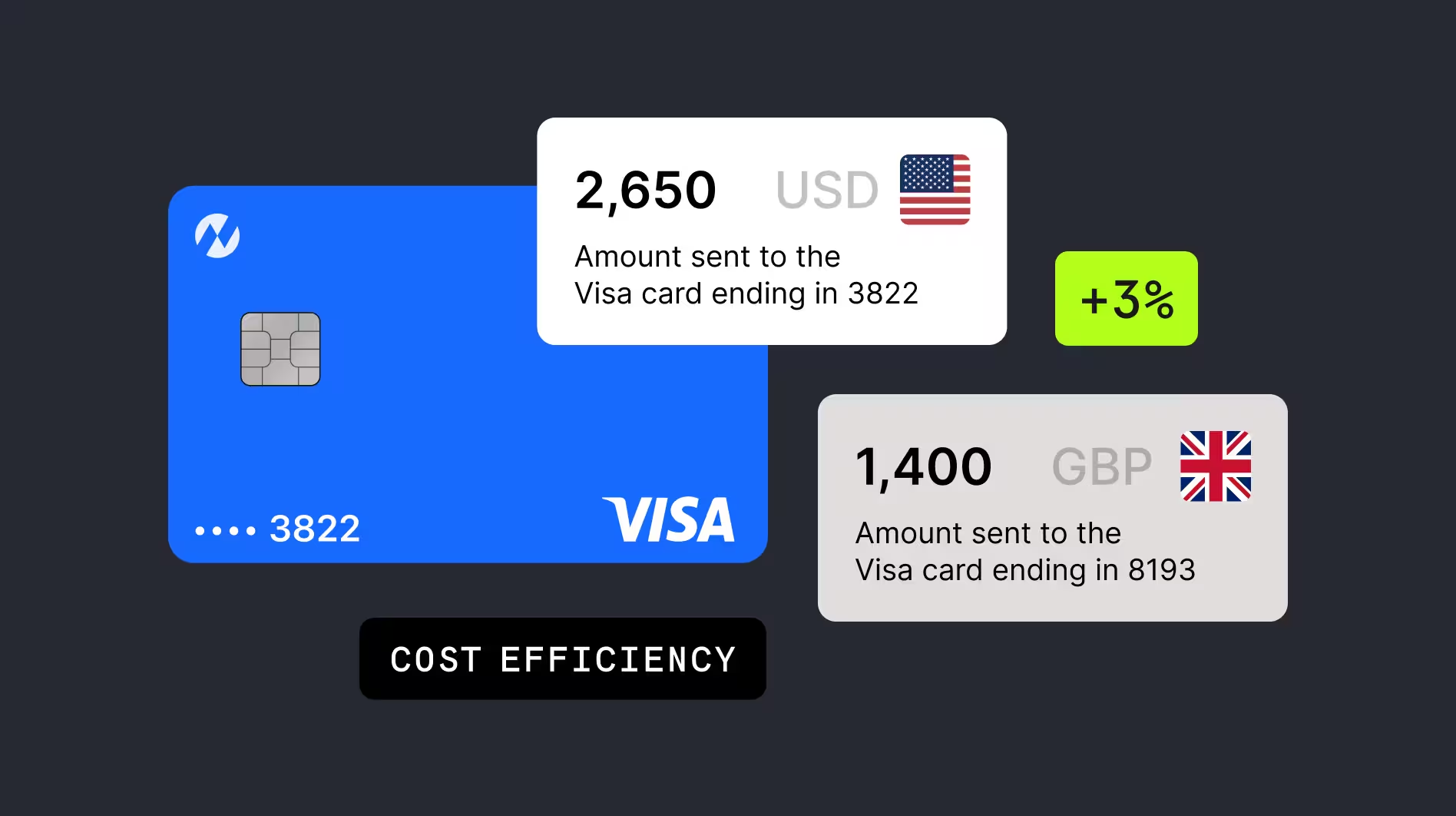
The optimal payment strategy is deeply local. Our approach balances the data provided by billions of transactions with the knowledge of local preferences, approaches and issuer requirements. Because an authentication strategy that adds two percentage points of acceptance rate for Visa in the US will destroy performance for Mastercard in Germany. A network token that lifts recurring payments behaves differently for a streaming service than for a SaaS platform.
The granularity required goes deeper than country or network. In the EU, where Strong Customer Authentication (SCA) requires 3DS unless an exemption applies, some French issuers prefer one exemption method and German issuers prefer another – and some French banks even split their preference by transaction size. A model measuring performance at the country or network level would never see this, and would leave real acceptance rate on the table. When issuer preferences shift, as they periodically do, nothing announces it – our system has to detect the change from the data and reroute traffic on its own.
That granularity matters, but it isn't the whole answer. The mechanisms of payment optimization keep changing – network tokens barely existed a few years ago and are now one of our biggest levers, and Data Share, stablecoin payments, and new regulation are already introducing the next set. A model has to be built to notice new categories of opportunity, not just to master the ones we know about today.
These are not edge cases, they are the ground rules of payment acceptance at a global scale. Payment optimization is won issuer by issuer, market by market–not on average across all of them. We built our platform around that belief from the beginning: every optimization runs as a separate, independently measurable experiment with its own control group and its own success criteria. We can measure causal impact in isolation. We can reverse an experiment in seconds if something degrades.
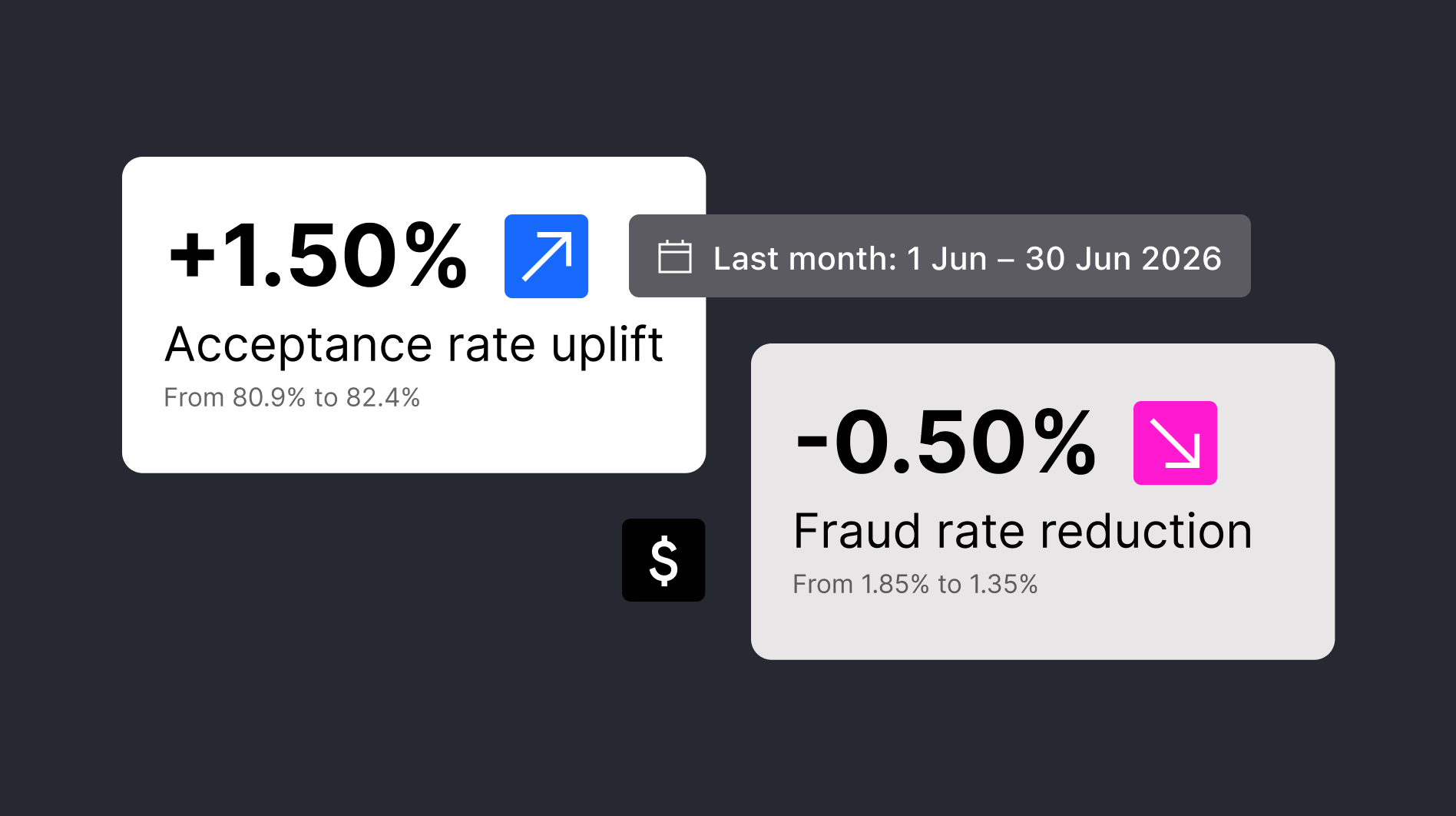
Across our merchant portfolio, the average uplift from Intelligent Acceptance is 3.8 percentage points. For a merchant processing $1 billion annually, that translates to roughly $38 million in revenue recovered from unnecessary declines every year.
The scale problem
This architecture, combined with deep domain expertise, has delivered best-in-class performance. Our payment success managers (PSMs) bring the judgment that matters – which issuer behaviors to address, which regulatory nuances deserve attention, which strategies are worth testing in which markets – and the platform provides the statistical rigor to validate it at scale.
But expertise has a ceiling. A PSM can deeply manage a finite number of optimizations at a time. At any given moment, we're running upwards of 200 live experiments across the platform, each testing a specific issuer, market, or scheme combination against a control group – the ones that fail get killed, the ones that succeed get promoted into live optimization strategies. That promotion is what actually moves the needle at scale: roughly 70% of all payments on our platform now flow through an optimization that started life as one of those experiments.
Even at that scale, the long tail of possible intersections – thousands of issuer-country-scheme combinations where the remaining basis points live – is far larger than any human team can cover alone.
Every serious payment provider has network tokens, smart authentication, and retry logic now. The question is: who can find the next 100 basis points, and how fast?
Agents as force multiplier
This is where our investment compounds most visibly.
We built an AI agent layer that operates continuously across our optimization platform. The agents don't replace our PSMs but rather, they multiply them. Every insight a PSM develops about issuer behavior in one market gets systematically tested across others. Every regression in a live optimization gets caught before it costs merchants revenue. Every untapped segment in the long tail gets identified and surfaced for experimentation.
Every proposal the agents generate comes with a full metrics picture: current performance, expected impact, fraud implications, and gate criteria. A payment expert reviews and approves. Experiments start conservatively and graduate through statistical gates. The agent’s adaptations to our model always receive human judgment; the agents extend the reach of that judgment across the entire portfolio, and are slowly learning how we think enough for humans to take more of a step back and let the agents experiment themselves with clear algorithmic guardrails.
The numbers tell the story. In 2025, our platform ran 10.5 billion individual optimizations. We recovered $11.2 billion in merchant revenue that year alone – 1.5x the $7.3 billion saved through all years prior. And in the first few months of 2026, another $2.2 billion was added, showing that the model is running faster now than it was at the start of the year.
What this enables next
The same infrastructure that powers optimization for the world's largest merchants is the foundation for what comes next. The expertise we've built across issuers, schemes, markets, and the specific intersections where acceptance is won doesn't have to stay locked inside a team of specialists. Agents are how that knowledge generalizes: applied to more merchants, more market combinations, more edge cases than any human organization could cover alone.
The merchant that once needed a dedicated payment expert now gets access to the same optimizations that the largest platforms in the world run on. That's not a distant roadmap. It's where this architecture was always heading.
The infrastructure was waiting for it. Now it's arrived.


.png)

.avif)