

Australia is about to change how every card transaction in the country is priced. On 31 March 2026, the Reserve Bank of Australia (RBA) published the conclusions of its Review of Merchant Card Payment Costs and Surcharging – Phase 3 of its Review of Retail Payments Regulation.
The reform includes three main elements: it allows designated card networks to impose no-surcharge rules, lowers interchange fees, and introduces new transparency requirements for card schemes and acquirers. The first changes land on 1 October 2026. A further cap on foreign-issued card interchange follows on 1 April 2027.
For merchants accepting cards in Australia, this may affect what can be charged as a card payment surcharge, the cost of accepting certain cards, and the information available for comparing providers. Here's an overview of the changes and some operational considerations.
General information only: This article is not legal, regulatory, tax, or commercial advice and does not assess any business’s specific obligations. Network rules, laws, regulations, and provider agreements may differ. Merchants should confirm how the changes apply to their own arrangements with their payment service providers (PSPs) and professional advisers.
What's changing
Card payment surcharge rules change.
From 1 October 2026, EFTPOS, Mastercard, and Visa will introduce no-surcharge rules that will generally prohibit card payment surcharges on their networks. American Express, UnionPay, and PayPal have also announced changes to surcharging, although they are not currently subject to the RBA’s formal regulation. While the RBA allows designated card networks to impose no-surcharge rules, it does not directly regulate merchants.
The availability of any exception will depend on the applicable network rules, law, or regulation. Merchants should confirm the position with their PSP.
A fee that is charged, or varies, because a customer pays with a particular card may be treated as a card payment surcharge. The applicable treatment depends on the purpose and operation of the fee, the network rules, and the relevant provider arrangements; the label alone should not be relied upon. Fees for services such as terminal rental or transaction processing are treated differently from a card payment surcharge under the RBA’s FAQs.
Interchange comes down.
The RBA is changing interchange fee caps for specified card transactions acquired in Australia.
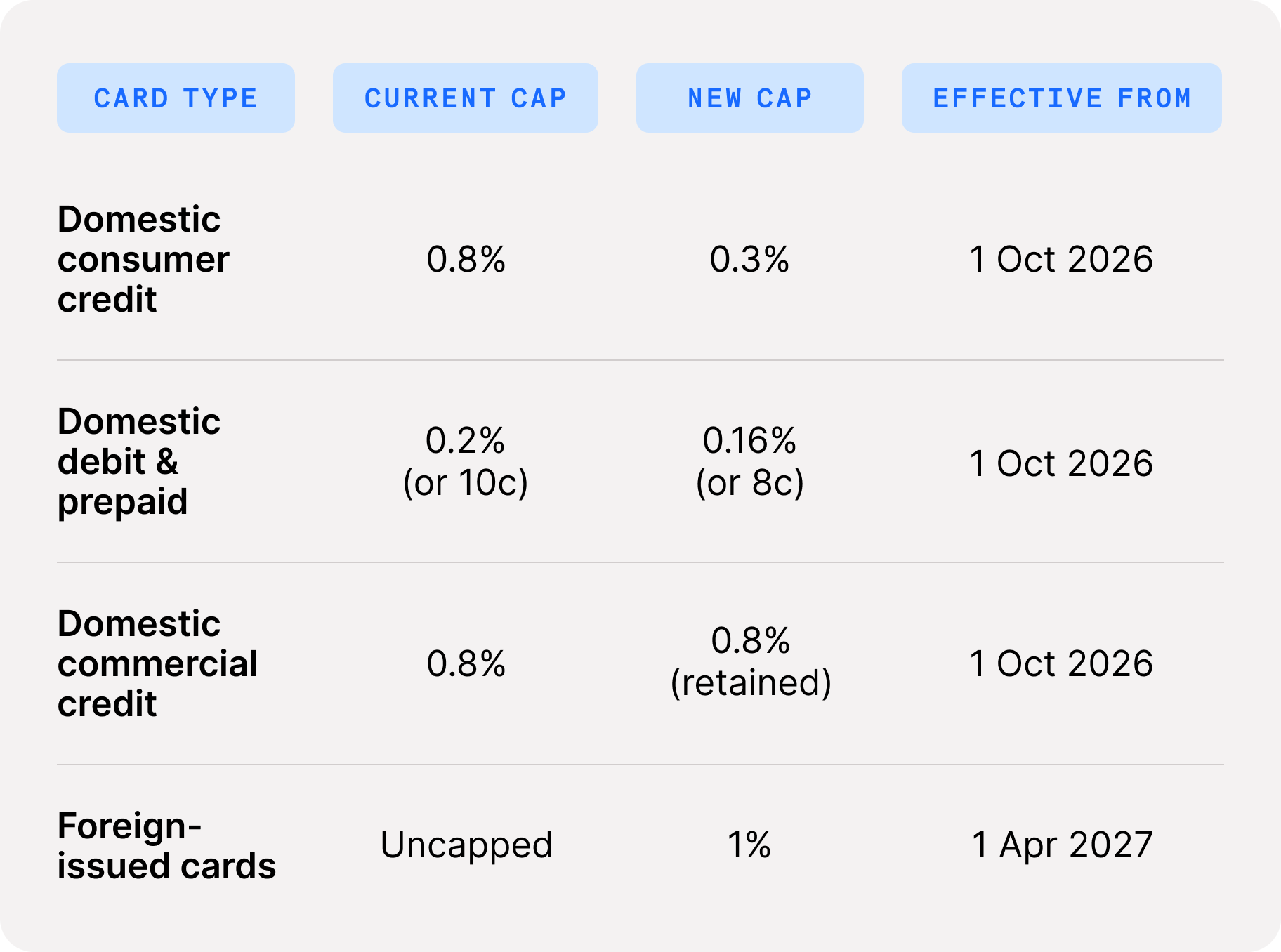
The foreign-issued-card cap applies to foreign-issued debit, prepaid, and credit cards acquired in Australia. An interchange cap is not a cap on a merchant’s total merchant service fee or processing cost.
Fees become transparent.
Card networks and certain large acquirers will be required to publish specified fee information. Acquirers will also be required to provide more information in merchant statements from 1 April 2027. These disclosures are intended to make provider pricing and interchange pass-through easier to assess. Their usefulness will depend on the merchant’s pricing arrangement, transaction mix, and provider reporting.
Foreign-issued card changes follow a separate timeline.
For merchants operating a cross-border ecommerce model or processing foreign-issued cards through an Australian acquiring entity, the timing and impact of the reforms may differ from domestic card payments. The surcharge prohibition is determined by the location of the acquirer, not the cardholder or issuing bank. The RBA’s interchange reforms refer to transactions acquired in Australia. The network no-surcharge rules are expected to apply broadly, including to internationally issued cards, but the detailed treatment will depend on the applicable network rules and provider arrangements, so merchants need to confirm how the changes apply to their setup.
The new 1% interchange cap for foreign-issued cards begins on 1 April 2027, separately from the domestic interchange changes taking effect on 1 October 2026. The effect on any business will depend on its card mix and pricing arrangement.
What this means in practice
Merchants will continue to incur costs when accepting card payments. Those costs may be reflected in overall pricing rather than charged as a separate card payment surcharge. Lower interchange may reduce some underlying acceptance costs, but the effect on a particular business will depend on transaction mix, provider pricing, and whether relevant reductions are passed through.
Checkout.com does not support surcharge capability in Australia, so all merchants processing with us are compliant on this front and no technical changes need to happen. However, we recognize that many merchants operate in a multi-PSP model – so we want to make sure you have the right information and some general guidance on how to proactively manage this change with the rest of your payments setup.
By reviewing both your setup with Checkout.com and other acquirers, you can proactively manage this change and gain full visibility into your costs.
For consumers
Consumers have a simpler experience at checkout, with greater upfront pricing certainty. When a card payment surcharge is removed, it may be easier for them to understand the total cost before completing a purchase. The RBA estimates that consumers currently pay approximately $1.6 billion of the total $1.8 billion in annual card surcharges on designated card networks.
Removing card specific surcharges reduces the risk of unexpected fees appearing late in the payment journey, helping to build trust between consumers and businesses.
For small merchants
Smaller merchants tend to pay fees closer to the current interchange caps, so lower interchange may provide greater wholesale-cost relief. They’re predicted to save $190 million a year after the surcharging rule changes come into place.
At the same time, merchants that currently surcharge may have less room to absorb the loss of surcharge revenue while any reduction in provider pricing flows through.
The effect will depend on the business’s pricing model, transaction mix, provider arrangements, and whether it currently applies surcharges. The RBA estimates that domestic issuers’ interchange revenue could decline by approximately $660 million annually, assuming no other changes in behaviour.
For enterprise merchants
If a business currently applies card payment surcharges, operates on thin margins, accepts a high proportion of commercial cards, or processes significant volumes of foreign-issued cards, the business may wish to assess how the changes interact with its own pricing and provider arrangements. Merchants on blended or bundled pricing arrangements may not see the full effect of an interchange-cap reduction in their own pricing. The new disclosures may provide additional information for assessing those arrangements.
Merchants may also wish to understand what routing options are available through their providers, including any least-cost-routing options for debit transactions. The RBA has published implementation dates for the reforms. Network rules, provider implementation details, and any available exceptions should be confirmed with the relevant provider.
Checkout.com can help merchants understand their Checkout.com payment flows, reporting, and pricing arrangements in the context of these changes and how they could improve overall payments efficiency.
Review current pricing: Our IC++ pricing and granular reporting provide greater visibility as merchants adapt to the new rules. For Checkout.com merchants currently on a blended rate, we recommend switching to IC++ pricing.
Manage costs: Our optimization tools increase acceptance rates to help merchants capture more revenue and drive higher margins at scale. And with EFTPOS now live on Checkout.com’s acquiring platform in Australia, merchants can reduce processing costs for all eligible domestic debit transactions as part of their wider cost mitigation strategy.
How to prepare
Assess the potential impact
Merchants may wish to assess current surcharge revenue, card acceptance costs, and the potential effect of the new interchange caps. They may also wish to confirm how any relevant changes operate across checkout, POS, payment links, recurring payments, wallets, and fallback routes.
Review provider arrangements
Merchants may wish to ask their payment provider how relevant interchange changes are reflected in their pricing, statements, and contractual arrangements. They may also wish to compare the visibility provided by different pricing structures, including IC++ and blended pricing.
Confirm customer facing and technical flows
Merchants may wish to review whether card payment surcharge logic or references appear in checkout, POS, terminal software, payment links, recurring payments, wallets, customer-facing terms, or other payment flows. Implementation timing may differ by provider and payment channel. Merchants should confirm any required changes and testing arrangements with their payment providers. For network-backed information on the announced no-surcharge rules, see Australian Payments Network’s card surcharge portal.
Consider customer communications
If pricing or payment options change, merchants may wish to consider how those changes will be communicated to customers.
Review available data and routing options
Once the relevant fee data becomes available, merchants may wish to assess how it informs provider comparisons and any routing options available through their payment providers.
Review payment orchestration and gateway arrangements
Merchants using payment orchestration should confirm that payment-method, routing, and fee logic is configured consistently across the relevant payment rails. No product configuration should be described as guaranteeing compliance.
Merchants with multi-gateway setups may wish to review how any changes are applied consistently across gateways, hosted checkout pages, payment links, recurring payments, wallets, and fallback routes.
Plan for April 2027
Merchants with significant volumes of foreign-issued card transactions may wish to consider the separate 1 April 2027 implementation date for the foreign-issued-card interchange cap.
The effect will vary by business. There is no single approach for every business. The right considerations will depend on the business entity, pricing model, transaction mix, customer base, and provider setup.
One thing is certain: regulatory change of this scale is easier to navigate with a payments partner that understands both the mechanics and the market – and can help businesses understand the cost of their acceptance.
The bottom line
Phase 3 of the RBA’s Review of Merchant Card Payment Costs and Surcharging is intended to make certain card acceptance costs more transparent and lower some interchange caps. From 1 October 2026, card payment surcharges will generally no longer be available on the networks introducing no-surcharge rules, and merchants may reflect payment costs in their overall pricing rather than as a separate card surcharge.
How quickly interchange savings reach an individual business will depend on its card mix, pricing structure, provider arrangements, and the operation of relevant network rules. But the dates aren’t moving.
Want to understand what the RBA reforms could mean for your cost of acceptance? Talk to our team, or contact your Checkout.com account manager to review your current pricing and routing setup. For advice about your obligations, consult your own legal or compliance adviser.
FAQs
- Does this mean card payments will be free for merchants?
Merchants will continue to incur costs when accepting card payments; the change concerns whether those costs may be recovered from customers as a separate card payment surcharge.
- Are B2B or commercial card payments exempt?
Merchants should not assume so. There is no general exemption in the RBA reform; the treatment depends on the applicable network rules, law, regulation, and provider agreement.
- What if an invoice was issued before 1 October but the customer pays afterwards?
If the card payment is made on or after 1 October 2026, a surcharge may no longer be available even if the invoice was issued earlier. Merchants should confirm the treatment with their payment service provider (PSP).
- Do the reforms cap scheme fees as well as interchange fees?
The reforms do not mean that scheme fees or total processing costs will change by the same amount as a particular interchange cap. The effect will depend on the business’s pricing arrangement and provider costs.

.png)




%20thumbnail.png)

.png)


%20(1).png)