%20(1).jpg)

OpenAI has evolved its approach to commerce inside ChatGPT, moving away from ‘Instant Checkout’ – where purchases are completed directly in the chat search results – in favor of merchant-controlled checkout models.
It’s a shift toward a more scalable model:
AI handles discovery and intent; merchants retain control of checkout.
OpenAI’s Agentic Commerce Protocol (ACP) is also expanding. What began as a way to support transactions is extending beyond payments to support product discovery and richer commerce interactions.
Some early interpretations have framed these changes as a retreat from in-chat commerce. In reality, the shift is more structural than directional.
AI is becoming a new shop window for commerce, while merchant infrastructure remains the system of record.
What Instant Checkout actually did
Instant Checkout introduced a new interface layer within ChatGPT.
Shoppers could discover products and complete a purchase without leaving the conversation. The checkout experience appeared native to the chat environment.
However, behind that interface, merchants still operated the transaction:
- Payments
- Order management
- Fulfilment
- Refunds
- Customer support
In practical terms, ChatGPT surfaced the experience, but the merchant remained responsible for the underlying commerce infrastructure.
What’s changing now
Rather than completing purchases entirely within ChatGPT, transactions are moving into merchant-controlled environments.
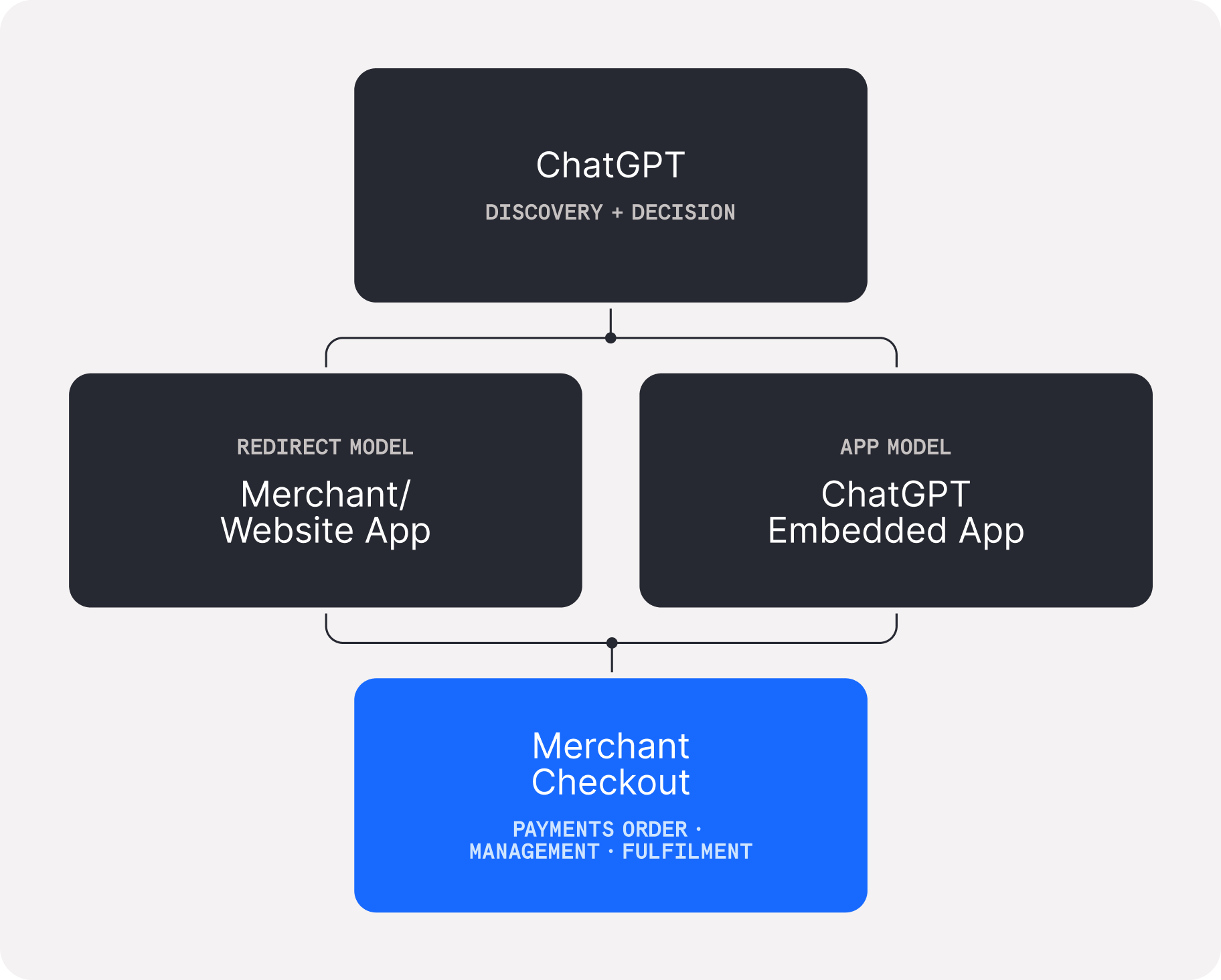
In practice, this creates two primary models:
1. Redirect model
The shopper is guided from ChatGPT to the merchant’s website or mobile app to complete checkout.
2. App model
Merchants build dedicated experiences within ChatGPT using OpenAI’s SDK, with checkout powered by their own infrastructure via delegated payment flows.
In both cases, the principle is consistent:
The merchant owns the checkout, not the AI platform.
This positions ACP as an enablement layer, rather than a marketplace intermediary that sits between the merchant and the transaction.
What the change reflects
This change is driven by both user behavior and operational reality.
Consumers already move fluidly between environments when shopping online – researching in one place, purchasing in another. AI accelerates this behavior by improving how quickly and confidently decisions can be made.
At the same time, checkout is deeply tied to merchant-specific requirements:
- Inventory and fulfilment logic
- Promotions and loyalty
- Regional payment methods and compliance
- Customer account systems
These are not easily abstracted into a single, universal interface.
A merchant-controlled checkout is also a more practical model to scale, reducing implementation complexity and lowering the lift required from merchants to support agentic commerce.
The model that is emerging is not AI-owned commerce, but AI-orchestrated commerce – where intent is generated in one layer and executed in another.
What this means for merchants already preparing for ACP
For merchants preparing for agentic commerce, this shift increases clarity – not complexity.
The foundations remain the same:
- Support for delegated payment and tokenized credentials
- Structured, high-quality product data for AI-driven discovery
- Flexible, API-driven checkout infrastructure
- Resilient payment systems that can handle demand from new entry points
What is changing is how customers arrive.
Increasingly, purchase intent will be formed before a shopper ever reaches a merchant’s owned channels. AI assistants will act as a qualification layer – narrowing options, shaping preferences, and accelerating decisions.
Merchants need to be ready to both:
- Surface effectively within AI-driven discovery, and
- Convert intuitively when that demand is routed to them
How this compares to other approaches
OpenAI is not alone in defining this space.
Google’s Universal Commerce Protocol (UCP) – alongside initiatives from card networks and other ecosystem players – is exploring similar problems from different angles.
Where these approaches differ is in control:
- Some models keep checkout within platform-owned environments
- Others, like ACP, prioritize merchant ownership of the transaction
It’s still early. Standards are evolving, and fragmentation is likely to persist in the near term.
For merchants, the priority is still maintaining the flexibility to support multiple models rather than anchoring on a single model too early.
Where Checkout.com fits
In a fragmented and evolving ecosystem, payments infrastructure becomes a critical translation layer.
Merchants shouldn’t need to rebuild their checkout every time a new protocol or platform emerges.
Checkout.com enables businesses to support agentic commerce across models – translating between protocols like ACP, UCP, and emerging network-led approaches – while maintaining control over performance, authorization, and customer experience.
As discovery and transaction become increasingly decoupled, the ability to support both without introducing friction will define competitive advantage.
The new discovery layer
One trend is already clear.
AI assistants are quickly becoming a powerful interface for product discovery and purchase intent.
What remains in flux (for now) is how that intent turns into a completed transaction.
Merchants that prepare for both sides of that journey – enabling AI systems to understand your products, while ensuring your payments infrastructure is ready to convert demand wherever it appears – will be best positioned to capture the opportunity.
At Checkout.com, we are actively supporting merchants exploring agentic commerce models today. If you’re evaluating ACP or other emerging protocols, our team can help you pilot and integrate these experiences into your existing payments stack. Get in touch to learn more.

.png)




%20thumbnail.png)

.png)

