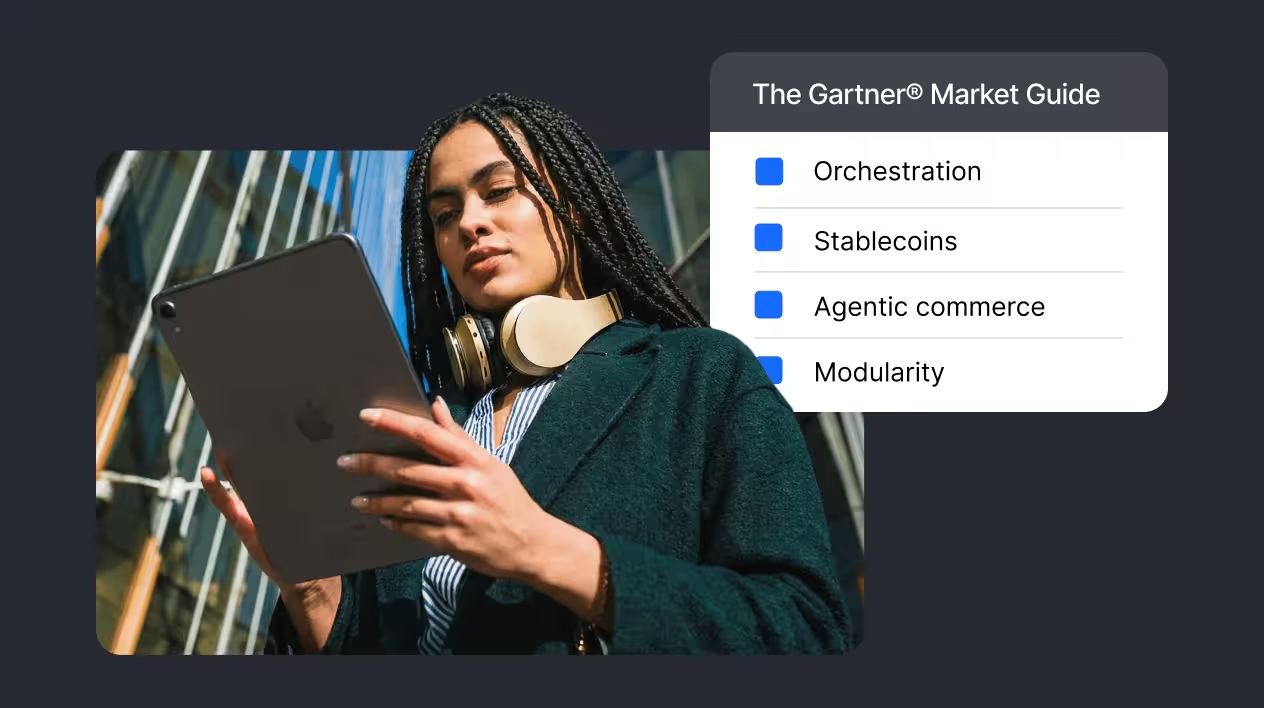
Gone are the days of payments being considered a back-office function. According to the newly published Gartner Market Guide for Digital Commerce Payment Platforms, they are firmly a strategic growth accelerator, shaping customer experience, global expansion, and revenue in equal measure.
As digital commerce leaders navigate an increasingly complex payments ecosystem, Gartner highlights several critical shifts that every business should understand when choosing the right payments partner. Here’s what we think matters most, and what it means for your business.
It’s more than just transactions
Gartner defines digital commerce payments as technology solutions that integrate with online merchant or business channels to accept, authorize, process and settle payments securely and electronically. Vendors offer these platforms as software as a service (SaaS) or payments as a packaged service (PaaPS).
What’s changed over the years is how these platforms are being used. Beyond processing transactions, payments are giving merchants access to growth. Leading platforms now offer modular, composable capabilities that help businesses improve acceptance rates, expand into new markets, manage fraud, and adapt quickly as customer expectations evolve.
Gartner recommends that digital commerce leaders responsible for digital commerce payment platforms should treat payments as a strategic business function. Select vendors that provide opportunities to increase revenue and profit through value-added services that allow you to manage the payment experience and optimize acceptance rates.
Flexibility over lock-in
Payment orchestration has become one of the most talked-about concepts in payments, and for good reason.
How does Gartner define payment orchestration? It’s a platform with the ability to connect the payment gateway to multiple payment service processors (PSPs), intelligently route and optimize transactions, protect sensitive data, manage fraud and risk, and analyze performance.
All of those capabilities mean orchestration improves acceptance rates, reduces costs through least-cost routing, and increases resilience by avoiding reliance on a single processor. The best platforms allow businesses to configure routing rules themselves or use AI-driven logic to improve every transaction dynamically.
The takeaway? Flexibility matters. Businesses should prioritize partners that offer orchestration without forcing them into rigid architectures or unnecessary vendor sprawl.
Stablecoins are moving from experiment to infrastructure
With new regulatory frameworks like MiCA and the GENIUS Act, stablecoins are no longer fringe. In 2024, total transfer volume hit $27.6 trillion, surpassing the volume of traditional card networks.
Payment platforms are responding by adding stablecoin acceptance, partnering with crypto infrastructure providers, or issuing their own stablecoins. Gartner expects merchants will require wallet interoperability as part of stablecoin payment acceptance to enable them to accept any stablecoin from any stablecoin wallet.
For businesses, stablecoins represent an opportunity to reduce cross-border costs, settle faster, and unlock new global use cases. But success depends on choosing a payments partner with the scale, compliance posture, and roadmap to support stablecoins safely and pragmatically.
Agentic commerce is redefining the checkout
Perhaps the most disruptive insight in the report: by 2030, Gartner predicts that AI agents will replace 10% of traditional online checkout interactions on a merchant’s website to make payments for consumer purchases using a credit card.
This shift toward agentic commerce introduces new requirements for payments platforms, including one-click checkout in conversational interfaces, AI-aware fraud prevention, and compatibility with emerging standards like OpenAI’s Agentic Commerce Protocol, Google’s Universal Commerce Protocol, as well as Visa’s Trusted Agent Protocol and Mastercard’s Agent Pay framework.
Businesses must start evaluating whether their payments infrastructure is ready for a world where transactions are initiated by AI agents and not humans. Gartner advises leaders to assess vendor plans now, as implementing secure agent payments will be complex and ecosystem-dependent.
What can you do to prepare? Ensure your product catalogs are visible and accessible to agents via standardized APIs and product feeds. We’re seeing success when merchants prioritize signals like real-time pricing and delivery dates to help agents make informed decisions.
Customer experience is the ultimate differentiator
Across every trend, one theme stands out: customer experience. Gartner emphasizes the importance of a unified payment experience across online and mobile channels, enabled by shared tokenization, consistent payment methods, and a smooth checkout.
Features like one-click checkout, preferred payment methods, and localized payment options are now expected. Businesses that fail to deliver smooth, trusted payment experiences risk lost conversions, higher fraud costs, and reduced customer loyalty.
What merchants should look for in a payments partner
When selecting a digital commerce payment platform, businesses should prioritize partners that offer the following:
- Global coverage without complexity
- Modular, composable capabilities
- Built-in optimizations for acceptance and fraud
- Support for emerging models like stablecoins and agentic commerce
Ready to future-proof your payments strategy?
We have built a global network centered around performance and turning payments into an invisible growth engine.
Checkout.com’s modular, full-stack platform brings together payment gateway, processing, and merchant acquiring under one roof, so you can move faster, lift your acceptance rate, and simplify your stack.
Beyond the core, you get the tools to go further, with advanced risk solutions, issuing capabilities, and funds management designed to help you protect revenue, boost efficiencies, and scale with confidence.
Finally, with multiple competing agentic commerce protocols emerging, merchants now face the difficult decision of which model to adopt. That is why we're building a connective layer across protocols, schemes, and AI-platforms, so merchants can plug into a single ecosystem and meet their customers where they are, however they want to shop.
Want to talk about how we can help you boost acceptance, simplify your stack, and deliver smooth payment experiences? Reach out to our team.
Disclaimer:
Gartner, Market Guide for Digital Commerce Payment Platforms, By Debbie Buckland, Peter Ryan, 12 January 2026
GARTNER is a trademark of Gartner, Inc. and/or its affiliates.
Gartner does not endorse any company, vendor, product or service depicted in its publications, and does not advise technology users to select only those vendors with the highest ratings or other designation. Gartner publications consist of the opinions of Gartner’s business and technology insights organization and should not be construed as statements of fact. Gartner disclaims all warranties, expressed or implied, with respect to this publication, including any warranties of merchantability or fitness for a particular purpose.






%20thumbnail.png)

.png)


%20(1).png)