
Online spending over the Black Friday/Cyber Monday (BFCM) weekend saw record-breaking 62% year-on-year growth across the Checkout.com network, we processed $5.2 billion in ecommerce over the four-day period, peaking at $1.6 billion on Black Friday. We supported you with an uptime of >99.999%, providing maximum opportunity for earning revenue over this critical period.
Performance is our priority. To us, that means safe, smooth and speedy payments for your customers. This BFCM, we processed transactions in 304ms on average – that’s 30% faster than last year. Thanks to our year-round engineering improvements, we put through 95% of transactions in less than one second.
What began as an in-person event in the US, Black Friday shopping events have increasingly moved into the global digital space. For instance, British consumers have dedicated more than half of their Black Friday spending to online channels every year since 2020.
This year was our biggest Black Friday yet. Congratulations to all our merchants, it’s a privilege to be on this journey with you.
Brit spending surged on electronics, retail and department stores
In the UK, consumer spending on Black Friday was 48% higher than the final Friday of October. This proves the ongoing relevance of the now-traditional seasonal shopping event.
Looking at individual categories, this Black Friday…
- Revenue on electronics/appliances stores increased 303%
- Spending in online department stores rose 190%
- Income from interior furnishings saw a 101% boost
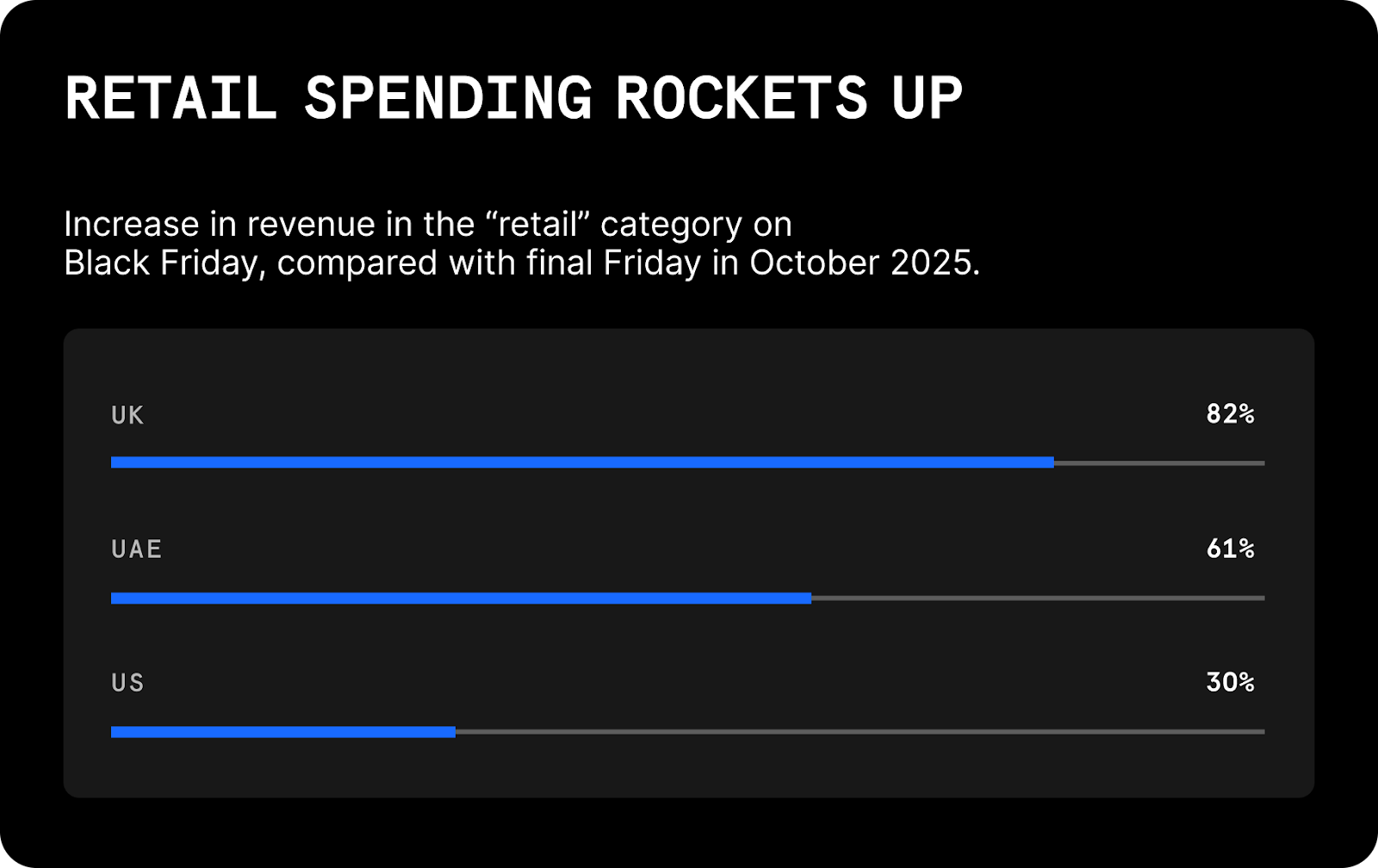
- Purchases in retail went up 82%
- Shopping at online clothes stores grew by 38%
The figures tell the story: Brits still see Black Friday as a prime shopping opportunity. Despite consumer sentiment trending somewhat negatively in aggregate this autumn, data from Checkout.com shows an encouraging uplift in revenue for merchants serving the everyday consumer.
Christmas shopping and cost-spreading are key for consumers
Spreading the cost of spending and getting organized ahead of important dates are strong motivators – almost half (47%) of Brits said they planned to start shopping for Christmas gifts before December. Just 6% of respondents planned to start the week before Christmas.
Survey results reveal ambivalence about the economic picture in the UK. Almost one in ten (9%) said they’re using credit or a loan to purchase gifts, and two in five (41%) are prioritizing gifts for close friends and family only. Just 5% of British adults said they are not giving gifts this year due to financial constraints. Around a third (34%) of consumers said they are not changing their gift-giving habits this year.
How and when are Brits shopping on Black Friday?
- Prime checkout time in the UK was 10am
- Spending increased 85% at 11pm
- A third (32%) of Brits said they were likely to use agentic AI for Black Friday
Our digital transaction data shows clear behavioral patterns. Likely eager to buy desired items while still in stock, Brits flocked to online stores in the morning. Black Friday shopping was most intense between 8am and 12pm – during this time, 32% of the day’s overall spend took place.
Likewise, spending patterns spiked again after 5pm, when many workers finished for the day. A final surge of web shopping took place in the hour before midnight, when consumers swiped and tapped to ensure they bagged the best deals before day’s end.
These periodic spending spikes highlight the need for reliable digital storefronts and a resilient payment system throughout the entirety of Black Friday. The diversity in spending habits between different consumer types means merchants can’t afford to miss the revenue rush due to an inferior technical setup.
As well as low latency and a good range of payment options, you should seek to minimize false declines for the best customer experience.
UAE consumers went all-in for clothing deals and travel bookings
On White Friday (as it's known in the Middle East), we saw a 39% increase in revenue in the United Arab Emirates, compared with the final Friday in October. Here are the key growth categories:
- Spending at online clothing stores grew 103%
- Revenue in the retail sector soared 61%
- Purchases at travel agencies increased 45%
This year, enthusiasm for purchasing clothes online was notably greater in the United Arab Emirates compared with the UK: Emirati spending on clothing was 103% higher on White Friday, compared to the final Friday of October. In the UK, the figure was a more modest 38%. This serves as a reminder for the importance of geo-targeted marketing in the run-up to the final weekend in November. If you’re selling fashion apparel in multiple markets and ad budgets are limited, then consider prioritizing the UAE over the UK.
Our network saw a considerable uptick in travel agency spending on White Friday – 45% higher than the equivalent Friday in October. The idea of “Travel Tuesday” (i.e. the day after Cyber Monday) as the day for deals on holiday bookings has quietly grown more popular in the US since 2018. However, it is only just beginning to appear in travel marketing campaigns in the UAE this year.
US shoppers favor digital deals and department stores
Compared with the final Friday of October, Black Friday in the US saw…
- Ramped up spending on digital goods (such as eBooks, music, apps, web services, and streaming), a category that grew 191%
- Enthusiasm for retail, with a 30% increase in spending
- More shopping at online department stores, leading to 20% more revenue
This is a welcome injection of energy into a rather mixed economic landscape in the US. Consumer research notes persistent frustration around the rising cost of living and a perception of weaker incomes. Towards the end of November, Americans were feeling rather negative about their spending power, with ratings on the Consumer Confidence Index on a consistent downward trend since 2021.
However, our data shows a positive upturn in online spending, particularly in digital goods, retail, and online department stores. Consumers were especially eager to sign up for on-screen entertainment, such as access to their favorite shows and eBooks. Analysts are describing this as a “K-shaped” economy, where those with more disposable income are raising their spending, and those without are cutting back.
As a nation, US consumers spent $11.8B online this Black Friday – and even more on Cyber Monday, when revenues reached $14.25B.
Partner for peak season success with Checkout.com
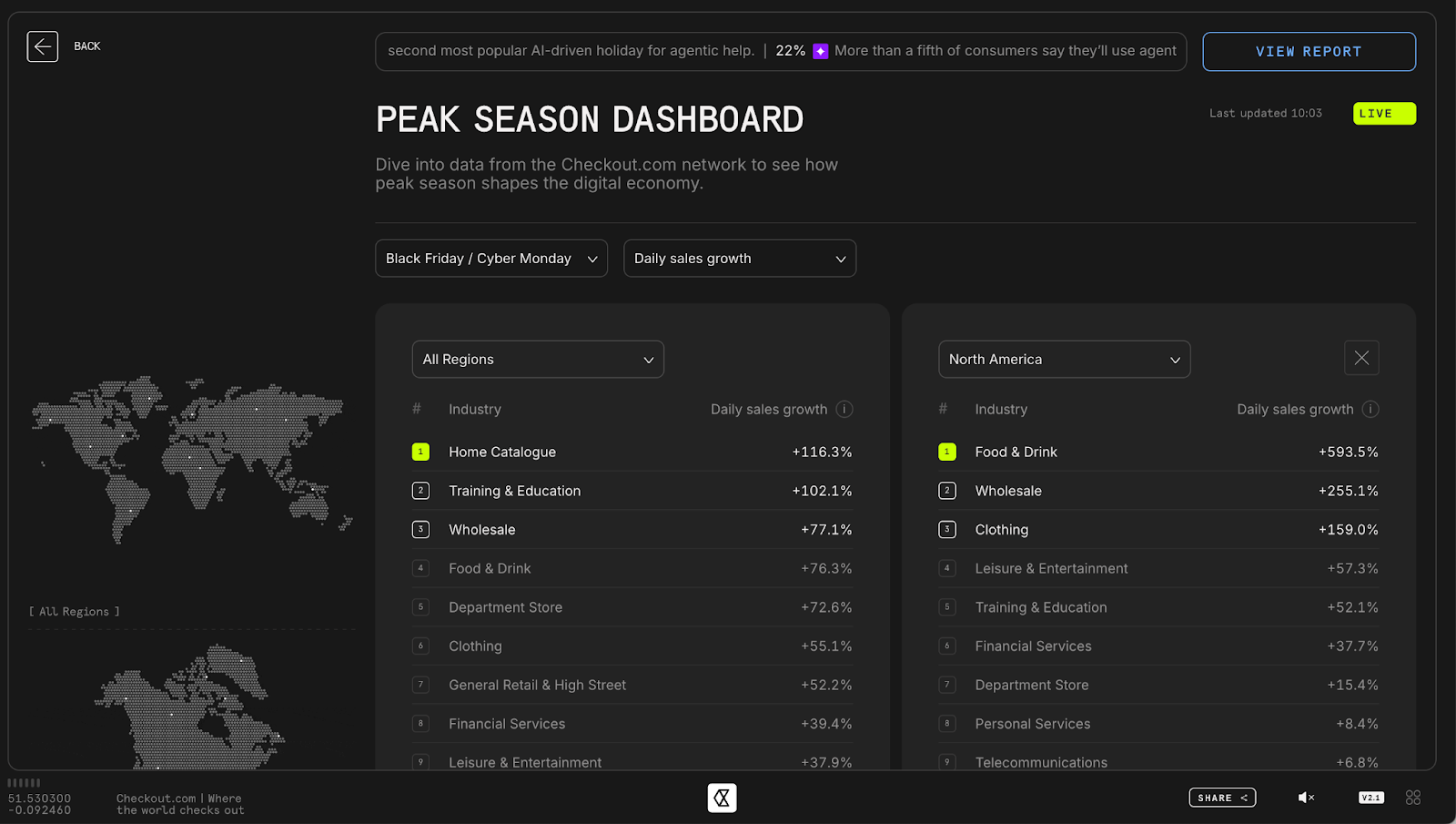
For us, success is always achieved in partnership. It’s your dedication to your customers that inspires us to improve payment performance each season. We know how critical peak sale periods are – particularly for online businesses. That’s why we prioritize transparency, resilience, and reliability. We shared our live metrics with you over Black Friday weekend, so you could follow the growth story as it happened.
Just like you, we’re improving every year. This BFCM, we processed +47% more individual cards compared with last year. If you want to know how you can improve conversion at checkout, fight friendly fraud, and make the most of agentic commerce, check out our dedicated peak season insights hub.
Data reporting methodology
For the purposes of reporting, our BFCM figures are compared with the equivalent day of the previous month (for example, Black Friday revenue is compared with revenue of the final Friday of October). All spending relates to online transactions only (for instance, via desktop or mobile).
In terms of geography, we have included payments from the issuing country of the relevant nation to entities in the same country. This means we’re looking only at domestic payments, excluding cross-border.
We have excluded merchant-initiated transactions from figures, to ensure we’re not counting recurring payments.

.png)





%20thumbnail.png)

.png)

